A 5GW AI Campus Turns Site Services Into Utility-Scale Planning
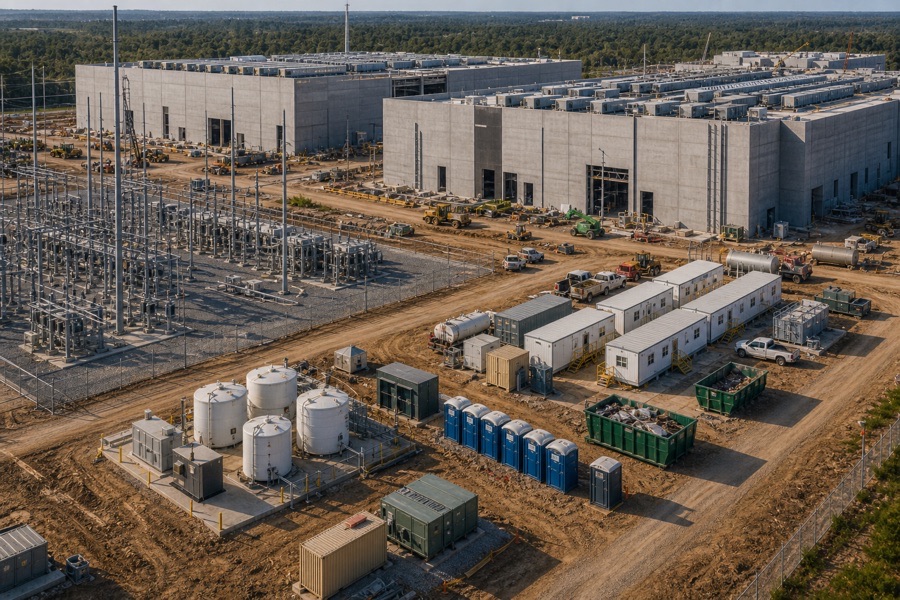
The short version. A 5GW, $50 billion AI data center campus is not just a building program. It is utility-scale construction pressure, and that changes how early teams should think about fuel, fencing, sanitation, waste, temporary offices, access routes, and backup vendor coverage. Koda supports vendor relationship follow-up for recurring site-service requests. The project manager still owns the project plan, field direction, safety, schedule, and onsite execution.
Source angle: Meta expands data center campus in Richland Parish, Louisiana, to 5GW & $50bn from Data Center Dynamics.
Why does this source matter for site services?
A campus measured in gigawatts can create overlapping service demand across land clearing, power infrastructure, road work, shell construction, equipment staging, commissioning, and operations support. Those phases need a service plan that can expand without pretending one vendor call solves the whole site. A headline about power, policy, construction activity, or infrastructure demand may not read like a fuel or sanitation issue at first glance. But when capital starts moving, nearby jobsites often compete for the same vendor bench.
The useful move is to translate the headline into service categories before the site is already urgent.
- Power-adjacent work can pull fencing, access control, fuel, waste, and temporary offices earlier than the main building schedule suggests.
- Sanitation, roll-off, and fuel vendors should be planned by zone and phase because campus-scale work creates multiple service centers.
- Backup routes and backup vendors matter when one delayed delivery or blocked gate can ripple across several scopes.
Why does 5GW change the service conversation?
A 5GW campus behaves less like one construction site and more like a small infrastructure district. Power yards, data halls, laydown zones, access roads, office trailers, and waste areas may all have different service rhythms. The risk is not only whether a vendor exists. It is whether the right vendor can reach the right zone at the right time.
The PM still owns the project plan, safety, site access, approvals, field direction, and sequencing. Koda should not be positioned as coordinating the build. Koda's lane is narrower and cleaner: help support vendor sourcing and relationship follow-up when the customer identifies recurring site-service needs.
What should be mapped before service demand spikes?
The service map should be built around zones, not just categories. A fuel request near power infrastructure may need a different route and approval owner than sanitation near the workforce parking area or dumpsters near shell construction.
- Zone map: data halls, substations, utility corridors, laydown yards, trailers, and crew-support areas.
- Phase map: clearing, civil, power infrastructure, vertical work, commissioning, and operations support.
- Vendor map: primary vendor, backup vendor, escalation contact, service window, and PM/customer-side approval contact.
Where does Koda fit without replacing the PM?
Koda fits between the customer and the vendor market. The customer submits a service need. Koda helps route the request, identify vendor options, support the relationship, and stay available for vendor follow-up. Koda is not the project manager and does not direct field work.
That distinction matters. The PM decides scope, timing, site access, safety requirements, sequencing, and whether a vendor is acceptable. Koda supports the vendor relationship so the PM does not have to start every request from a blank search.
What changes when the vendor relationship is managed?
An organized vendor relationship gives the project team one place to start for recurring site-service requests instead of a separate sourcing hunt for every category. Koda can help connect the request to vendors for fuel, sanitation, waste, fencing, workforce housing, and jobsite offices.
This is not a guarantee that every vendor outcome is controlled by Koda. It is a cleaner relationship layer: fewer cold starts, fewer scattered contacts, and a clearer path when a customer needs vendor options or follow-up.
Which requests should be started early?
Fencing, sanitation, waste, fuel, and workforce housing or jobsite offices should be scoped before the site feels urgent. Fencing affects access. Sanitation affects crews. Waste affects site condition. Fuel affects equipment. Offices and housing affect field-team logistics.
The exact order belongs to the PM and customer team. A remote energy site may need housing earlier. A dense commercial site may need waste and fencing first. A generator-heavy site may need fuel planning from day one. Koda's role is to help with the vendor relationship once the need is clear.
How is Koda paid?
Koda is paid two ways, and both are disclosed. The customer pays a defined project fee, scoped to the size and duration of the build and set in the proposal before anything is committed. Every awarded vendor pays Koda a fee that appears as its own line item on their monthly invoice, the same fee for every vendor bidding that category.
That matters because the fee does not scale with the award, so it cannot move a recommendation or a price. Koda is the procurement team for recurring site-service vendors, not a replacement for the customer's project controls, field supervision, safety program, or onsite management.
Frequently asked questions
What services can Koda help source?
Koda can help customers source vendor options for fuel, sanitation, waste, fencing, and workforce housing or jobsite offices.
How is Koda paid?
Two ways, and both are disclosed. The customer pays a defined project fee set in the proposal. Every awarded vendor pays Koda a fee that appears as its own line item on their monthly invoice.
When should a project team request site services?
A project team should request vendor options before mobilization, especially when nearby infrastructure or commercial activity suggests vendor demand may tighten.
Is Koda only for data centers?
No. Koda supports vendor sourcing for Texas data center, solar, energy, oil and gas, and large commercial jobsites that need recurring services.