Site Services Coordination on Texas Megaprojects: The Full Playbook
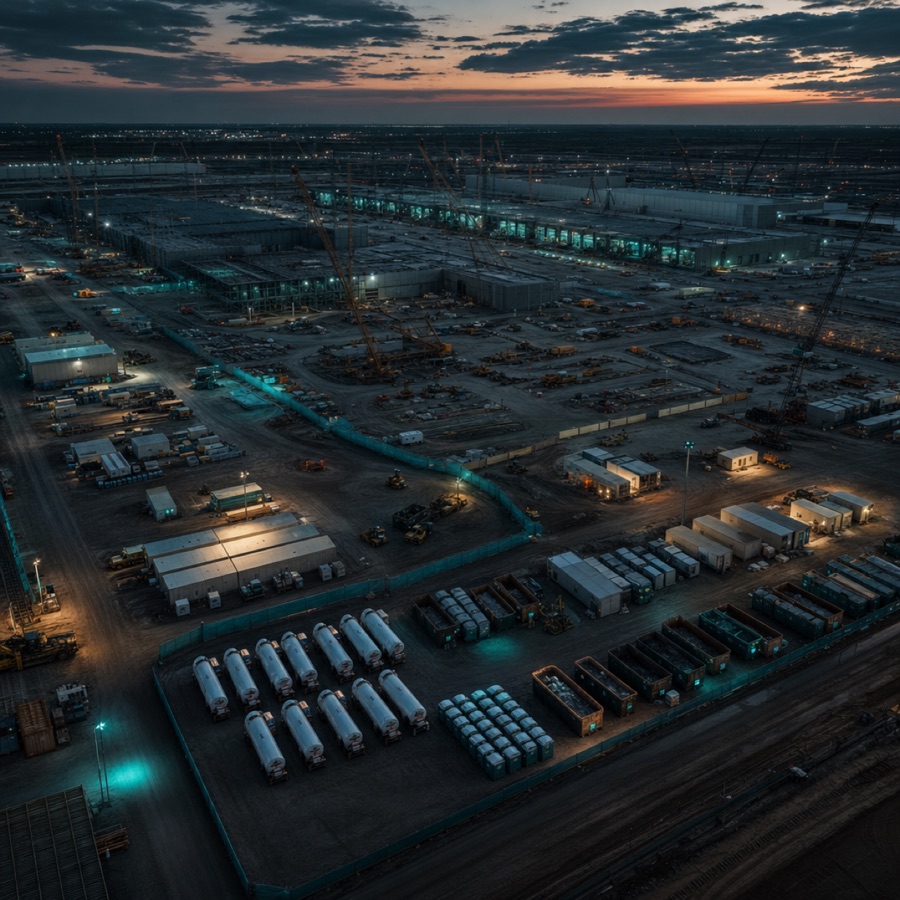
The short version. On a large Texas jobsite, the bottleneck is rarely the work itself. It is coordinating the recurring services around the work: workforce housing, remote offices, bulk fuel, sanitation, waste, fencing, storage, and more. Self-coordinating means a separate vendor, contract, invoice, and point of failure for each service to chase when something breaks. An outsourced procurement team collapses that into one relationship, for a defined project fee set before you commit. This is how that actually works on the ground.
What is site services coordination?
Site services coordination is the practice of managing the recurring services a jobsite depends on through a single point of contact instead of vendor by vendor. On a data center, solar, or energy build, the core work is construction. Everything around it (keeping the generators fueled, the crews with working restrooms, the debris hauled, the perimeter secured, materials stored securely, and remote workers housed) is site services.
Most project managers do not want to manage those services. They are recurring, they break at the worst times, and chasing them pulls attention off the build. A coordinator owns that layer end to end: sourcing vetted vendors, dispatching them, confirming fulfillment, and answering when something goes wrong.
Why do Texas megaprojects need a coordination layer?
Texas is in the middle of a data center and energy boom, and the sites are big, remote, and fast-moving. That combination breaks the usual "just call a vendor" approach for three reasons.
- Scale. A single megasite can burn thousands of gallons of diesel a week, need dozens of sanitation units, and fill multiple roll-offs a day. No single vendor covers all of it.
- Remoteness. West Texas sites are hours from the nearest supplier. A missed delivery is not a same-day fix. It is a day of idle equipment.
- Speed. Schedules compress. By the time a PM realizes the waste vendor never confirmed, the dumpsters are overflowing and OSHA is a phone call away.
How does the one-call coordination model work?
The model is simple: you post one request, and the coordinator handles intake, vendor matching, bids, dispatch, and fulfillment confirmation. Here is the actual flow on a coordinated site.
- The project team submits a request: service type, site, timing.
- Koda scrubs the request and routes it to vetted vendors who actually serve that area and service.
- Vendors bid. Koda validates the bids and the vendor before anything reaches you.
- You award. The vendor is dispatched, and Koda confirms fulfillment.
- If something breaks down, there is one number to call, not one per vendor.
What does Koda cost?
A defined project fee, scoped to the size and duration of the build and set in your proposal before you commit. It is a fee, not a percentage of your spend, so nothing Koda sources changes what Koda earns. Every awarded vendor also pays Koda a fee, and that one is printed as its own line item on their monthly invoice, the same for every vendor bidding that category.
The honest version: you are not underwriting this alone, which is why the project fee is what it is. The part you do not pay directly is not hidden from you. It is printed.
What does each coordinated service cover?
These services were chosen deliberately because every medium-to-large jobsite needs them and most teams do not want to run them.
- Workforce Housing. Modular man-camp housing for large crews, set up and managed on remote sites.
- Remote Offices. Mobile office trailers and site headquarters for your project team, delivered, connected, and managed.
- Bulk Fuel. On-road and off-road diesel, tank rental with monitoring, DEF, and scheduled bulk delivery timed to your burn rate.
- Sanitation. Standard and ADA portable units, handwash stations, and luxury trailers, with weekly service handled for you.
- Waste. 10 to 40 yard roll-offs, construction debris disposal, scheduled haul-off, and concrete washout.
- Fencing. Panel and driven perimeter fencing, privacy windscreen, access-control gates, and safety-compliance setup.
- Storage. Storage containers, conex boxes, and secure laydown for tools, materials, and equipment.
What separates a coordinator from a broker?
A coordinator stays; a broker disappears after the introduction. A traditional broker connects you to a vendor and collects a fee. A coordination layer owns the entire lifecycle (intake, vetting, bids, fulfillment confirmation, and dispute resolution) and is still reachable six projects later, holding the same standard. That permanence is the whole point: every new site you open inherits the relationships built on the last one, with no reset.
Frequently asked questions
What does a site services coordinator actually do?
A site services coordinator is a single point of contact that sources, vets, dispatches, and manages the recurring site services a jobsite needs (workforce housing, remote offices, bulk fuel, sanitation, waste, fencing, storage, and more) so the project team manages one relationship instead of many separate vendors.
Does using Koda cost more than hiring for it?
Compare it to the hire, not to going direct. Koda is a defined project fee set in your proposal, with no payroll taxes, benefits, recruiting cost or employment liability, and nothing carried between projects.
Which site services should be coordinated first on a new build?
Fencing and sanitation should be stood up before crews arrive, fuel as soon as equipment is on site, and waste once demolition or earthwork begins. Workforce housing is coordinated earliest on remote sites where crews cannot commute daily.
Is this only for data centers?
No. The same coordination model applies to solar farms, energy infrastructure, and large commercial projects across Texas. Any medium-to-large jobsite that needs recurring site services benefits from a single coordinated relationship.